
Cal.E.'s Korner

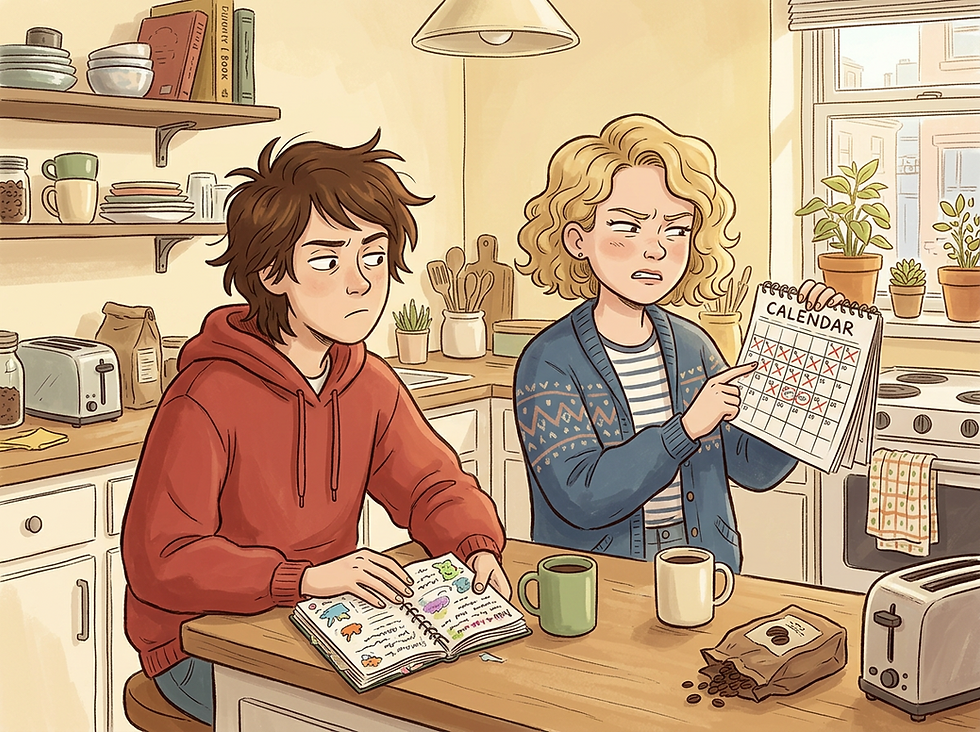
The calendar and the draft finally ended up in the same place. After enough pointing, sighing, and rereading of old notes, D.C. and Cal.E. reach the awkward truth.
No single person missed the blog posts.
The handoff failed.
The real culprit was the handoff
The handoff is the small but crucial moment when an idea becomes a task, a task becomes a draft, a draft becomes a finished post, and a finished post becomes something readers can actually see.
D.C. : I was working in the creative fog. Cal.E. was working in the schedule grid. Neither one made the crossing clear.
A good handoff answers plain questions:
Who is writing the post?
What shape is it in right now?
What still needs to happen?
Who decides it is ready?
What happens if it is not ready on time?
Without those answers, everyone gets to feel busy while nothing gets published.
That is exactly what happened here. D.C. had motion. Cal.E. had structure. The blog needed both, joined at the middle.
Instead, D.C. said, “Soon.
”
Cal.E. said, “Scheduled.”

The blog said nothing, because blogs are cruel that way. They only show what gets posted.
The apology draft becomes its own problem
D.: I have a rough draft of our apo;ogy post.
“Friends, readers, patient wanderers of the web...”
C.: NO!.
D.C. “We had planned a series of timely posts, but due to an unexpected alignment of creative reflection and calendar review...”
Cal.E. :NO
“That sounds like we got audited by a poetry club,”
“We missed a few days. We’re sorry. We’re back.”
D.:” Hmm. That is so short it needs a sweater.”
I suppose the truth is we missed the posts. We should have said something sooner. Let’s get back on schedule.
No fog machine. No grand excuse. No heroic tale of struggle against impossible odds. Just a clear note and a better plan.
That might not sound dramatic, but it is the kind of answer a quiet blog needs.
Let’s make a new agreement and LEAVE IT where WE both can see it
Cal.E.: This is not long. Long systems are easy to admire and hard to use. This one fits on a single sheet of paper.
Rule one
Every post has one clear owner.
That person does not have to do every part alone, but they carry the post across the finish line. If the post is stuck, they say so before the publish day disappears.
Rule two
Every sched
uled post gets a backup.
The backup can be a shorter note, a behind-the-scenes update, a republished favorite with fresh context, or a simple check-in. The point is not to fake productivity. The point is to keep the blog from going silent while a bigger piece takes shape.
Rule three
Missed posts get named quickly.
If a post slips, D.C. and Cal.E. do not wait three days to discuss the philosophy of deadlines. They call it what it is, fix the schedule, and move on.
Cal.E.: Let’sadd color coding.
D.C. What is “mood of the draft”?.
C.: This argument was silly, but the lesson is useful
The funny part is that we both care about the same thing.
D.: yes, we want the blog to feel alive. They want the posts to be worth reading. We want the small promise of a regular update to mean something.
C.: Our argument sounds like a personality clash, but it is really a common publishing problem. One person protects quality. Another protects consistency. If they treat those goals like enemies, nothing gets easier.
A blog needs standards, but standards cannot become a locked gate. It needs a schedule, but a schedule cannot pretend human beings never get tired, stuck, or distracted.
The useful middle is simple: publish good work, keep the rhythm honest, and do not let silence explain itself.
D.C.: Well, I admit that “almost ready” is not a publishing status.
Cal.E.: And a calendar square is not a completed post.
D.: Well, the next post will not fix the missed days by pretending they did not happen. It will fix them by appearing.
That is the only real cure for a quiet blog.
I suppose “eventually.” Is not a deadline.
Cal.E. : I’ll check and make sure that every square has a person attached to it…. D.C. five sentences makes a paragraph, not one or two.
D.: That is the standard for a typing class, but not always the case.
C.: Since you are hard at work writing, and I’m working on our schedule, I suppose we’re out of time for today, folks. That's the end of this cat ta(i)le.

Please join us next time for another edition of Cal.E.’s Korner.


Comments